Thursday, April 25, 2013

Garlic Harvest and "Made Over" Artichoke Stalks, plus a Lavender Festival.

Dear Folks,

This morning I harvested my garlic.  This year (actually October 1st last year) I decided to try elephant garlic for 'real' (I've grown it sporadically in the past).  I had picked up several heads while in California last year and through them into the crisper with the saved garlic from last year's harvest.

I think they did pretty good.  I was also surprised by the 'bulbets' semi-attached or attached to the main sides of the elephant garlic.

In the picture from left to right as you look at it is:  purple glazer regular garlic, the elephant garlic 'bulbets' in the container and the elephant garlic.

Some background on garlic, what I planted and elephant garlic.

The purple glazer is my favorite - I like the flavor, nice without being fire-starter spicey.  I saved mostly small heads for replanting and decided on a new bed with more sun this growing season so most of the heads are smallish.  Besides the starting size, I think some of the up/down heat/cool of last fall may have had something to do with the size.  I'm going to sun dry some of the smallest ones so I have dried garlic for grinding and using.

The little bulbets of the elephant garlic are new to me, but not completely surprising.  I've saved the flower-produced bulbets of the purple glazer and replanted.  They need 2 years to get to head producing growth pattern so I will leave them in the ground and hope for nice sized heads next year.

Both regular garlic (Allium sativum) and elephant garlic (Allium empeloprasum) are members of the onion family.  Elephant garlic is not actually a "garlic" but rather a Leek on Steriods, and has a milder (some think too mild) garlic flavor.  You can't see the leaves in the picture, but they are 'strappy' like leek and could be used to flavor foods.  In fact, even the stalk and leaves of either plant, which are generally disposed of after harvest, can be used to flavor soup, stews, and broths.

Hang your garlic to dry in the shade until the outside is papery - they will store will for a couple of months in your kitchen,  For longer term storage, place in a cardboard box in the crisper drawer of the frig.  This is also the way I store the heads I plant to split and re-plant next October 1st.  Do not store moisture containing vegetables in the same crisper - the moisture will case the bulbs to rot.

. . .

Next Up Artichoke Plants - all those leaves and edible flower heads. - "Made Over Artichoke Stalks.

Made Over is an old fashioned term for using left overs.  Now a days it refers to lowering the calorie content of a popular dish.

I like the old fashioned version because I'm always trying to find ways to use as much of a plant as possible.  I compost every paring from garden/produce that I can, but I would like to find ways to use as much of the 'parings' as food.  I save celery bottoms (when I don't replant them) and carrot bottom and tops, the peels of onions, woody parts of herbs etc. for making broths to make soups.

I've been busy harvesting the artichoke flowers and boiling and then marinating (like the marinated hearts you buy in the stores).  I also just froze some after boiling for use later in the year.

I've wondered about those huge artichoke leaves - until some wonderful person on the Valley Permaculture Alliance made mention of using artichoke leaves like cardoon leaves (the artichoke is related).  Then one wonderful cook posted on the subject about taking the celery looking artichoke leaf stalk and cleaning, dicing and cooking it up and voila - a wonderful addition to salads, soups and stews.  I am sharing the link below so you can see what she made.

I went right out and cut some stalks.  I pared the leaves from the stalks (some of them are 3 feet long even after you pare the leaves off.  I used the peeler to get any particularly stringy areas of the back of the rib (it really does look like a giant celery stalk) and then diced them up.  I tasted them - the notes said they were bitter raw - oh yes, quite bitter.  Filled a pot with salted water brought it to a rolling boil, dropped them in and cooked for 10-15 minutes (I done a couple of batches now - you want still crunchy not soggy), drained, cooled and tasted and was very, very pleased with the taste.  I call it "delicate" artichoke heart flavor.  It has been described as nutty maybe hazelnut - bottom line I call it wonderful.  I've added it to many salads now.  I may trying freezing some of the next batch just to see how well they stand up to freeze/thaw conditions.  I'm hooked on the "made over" artichoke stalk food.

The picture shows some leaves some trimmed stalk, some pared stalk and the diced stalk ready for boiling.  The color changes very little after boiling.

I did try even more made over by trying to create a green broth base from all the parings, but it came out bitter so I have to figure out what I did wrong.  Some folks were able to take more of the parings and create a flavorful vegetable broth base, so I'm assuming it was how I did mine.  More research needed :-)

Here is the link for the discussion on the Valley Permaculture Alliance site.  You can read any posts on the site, but if you want to participate in the discussions you need to join (free and easy) and become a member - I strongly encourage any of you in the valley (or similar desert climates) to join the discussions on gardening and cooking.

http://www.phoenixpermaculture.org/group/growinggourmet/forum/topics/artichoke-ribs

. . .

Next Up A trip to a Lavender Festival in June.

Folks, Promenade Travel out of Sun City has put together an over-night bus trip to the Lavender Festival at Red Rock Ranch in Concho, Arizona.  I am scheduled to go and provide some Q&A on the trip up.  I've been trying to make this trip for the last couple of years and something always came up.  Registration and payment are required ahead of time (as with most events they need a certain number to make it a 'go' and also can only accommodate a certain number on the bus).

Promenade has been doing these kinds of bus excursions for quite a while - I went on a day trip to Southern AZ wine country a couple of years ago and the whole trip was handle very well.

For all questions and registration use the contact info on the flyer - I am not involved in putting this together - I get to enjoy the trip and answer lavender questions :-)

https://docs.google.com/file/d/0Bz6z-WrYdnebZzQ0TF9BbkhETXM/edit?usp=sharing

Have a great day!


-- Catherine, The Herb Lady

Wednesday, April 03, 2013

Harvest Time - Late March - Early April

Dear Folks,

There is nothing like 'grocery shopping' in your own backyard.  Here are some pictures of the harvest for the last couple of weeks.

I harvested this batch for Easter dinner and salads this week.  The strange looking spirals are 'scapes' from my garlic which I used as a bed for the roasted chicken.  Also in the picture are sugar peas (I made a pasta dish with orzo and the sugar peas), the asparagus I sauteed with a tiny amount of a fat combination of olive oil, butter and natural bacon fat.  The carrots I poached in our blood orange juice.

Next is purple cauliflower - I do not usually grow 'head' veggies because they take up so much room, but I couldn't pass up a tiny transplant from Vilardi Gardens when I was at Root Phoenix in January and look what it did!  The purple and orange cauliflowers have more antioxidants than their white relative.  Going to be part of dinner this coming Sunday - on the grill they get some amazing taste going.


This morning (April 3rd) I harvested some artichokes and a bunch of my white and red alpine strawberries.

I am going to cook up the artichokes and marinate the babies and use the 'parings' for a broth - I finally found a use for the tough leaves etc. through a tread on the Valley Permaculture Alliance, to make a broth base for soup and I can't wait to try it out.  I so hate to just compost 'leavings' when I could 'make over' into something - before composting anything but meat and fat - recycling at its absolute best!!


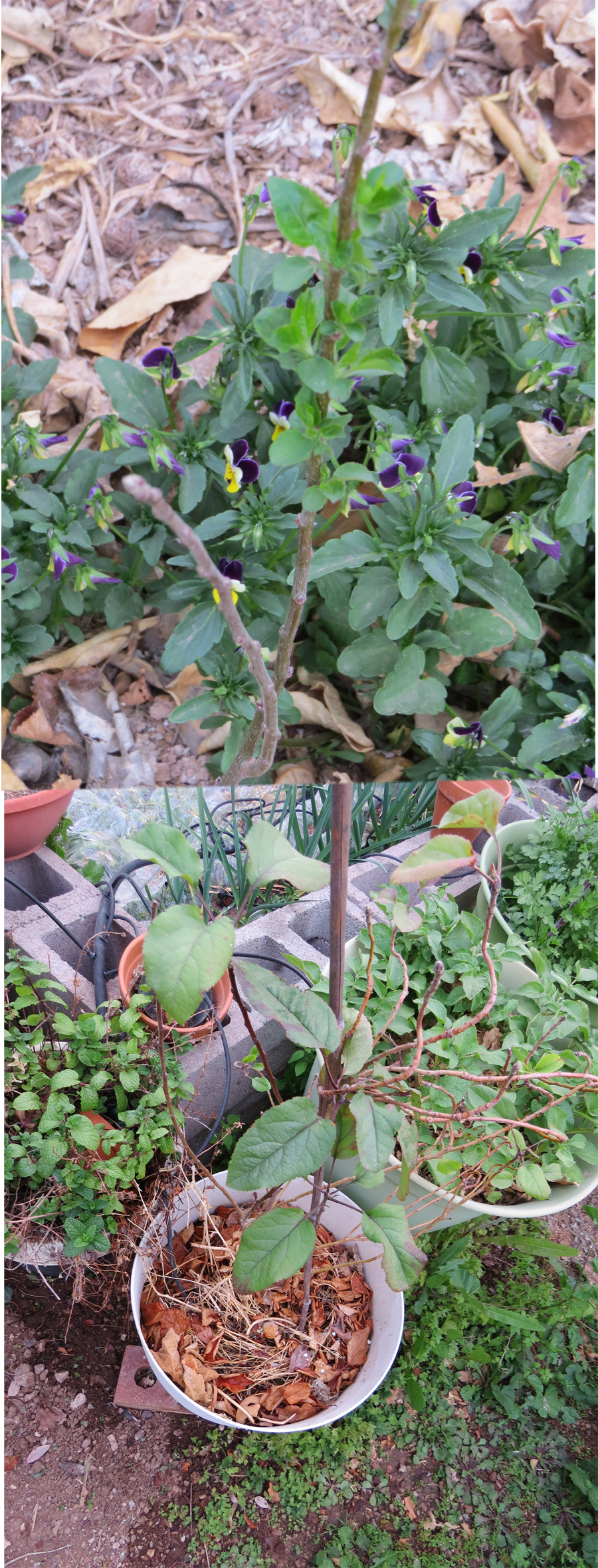
And finally, a picture of the Johnny Jump-Ups in the lawn.  I seed these in during the winter to give us something to look at while the lawn is dead - and of course they are edible so I can add them to salads or even the strawberries for additional visual delight.


I hope you enjoy this pictorial harvest.  Those new to gardening in the desert often think we can't grow things here either because of the heat or because of the chilly winters.  Even with the hard freeze we had this year the strawberries and lettuces were surviving just fine - thank you very much - and the artichokes and asparagus took off like green rockets as soon as the freezes were over.

Enjoy Spring!

P.S.  The wildflower season this year is great - we probably have another 2-3 weeks of spectacular blooms to see, so head out and catch the color.

-- Catherine, The Herb Lady

Wednesday, March 06, 2013

Seed Cracker Recipe and Frost Survivor

Dear Folks,

This recipe is one I know I tried out last year some time and for the life of me I can't find my notes, so I decided to give it another try and came up with this recipe for a Seed Cheese Cracker - it is also gluten free.

I first thought about this when one of the nice raw foods vendors was at the farmers market (they had a seed/nut cracker), then I found recipe ideas on the internet, some noted as gluten free others focusing on using good-for-you seeds and nuts, others on the low-carb forums.

The nice thing about this recipe is you can change out the seeds, nuts and cheeses or leave the cheese out altogether.  You can add any herbs of your choice.

A couple of points:  most of these come out like a 'mash' so you want to create a baking form that is even all the way around and the same depth all the way through so they bake evenly.  And you need to watch them so they don't burn.  It may help to turn the pan around half way through to more evenly bake.  They crisp up more as they cool and dry, so don't over-bake thinking they need to be bone dry at the end of the baking cycle.

Just a note of caution - these are addictive!  :-)

I've given the link for the original recipe that I modified mine from below the recipe.

SEED CHEESE CRACKER
1/2 cup of flax seed meal
1/2 cup of sunflower seeds (dried raw but not toasted), ground
1/3 cup of grated Parmesan Cheese*
1/2 teaspoon garlic powder
1/2 teaspoon salt
1/2 cup of water
Optional:  Any herbs of your choice either dried or fresh - if using fresh mince very finely.

Nuts/Seeds - use combinations that are appealing to you.  Stronger tasting seeds and nuts can be balanced with mild.  I think I might try a walnut/sunflower/basil/Parmesan next time.


Heat oven to 350.

I have a bullet grinder but you can use any kind of grinder you need to grind the seeds if not already ground.

Put all the dry ingredients in a bowl and stir, then add water and mix well so everything is moistened.

Spread on aluminum foil or silpat.  Cover with a piece of wax paper and roll out to even depth - about 1/8 - 1/4 inch, and even up the sides a bit by squaring off.  Use a long straight blade to score - you don't have to cut all the way through - it just makes it easier to break up after they cool.

Bake 15-18 minutes and watch carefully - if they start to brown too much remove and let cool.

This made 42 crackers for a total of approximately 771 calories, 37.45 grams of protein and 22 grams of fiber.  I have used a formula I came up with to measure the nutrient density of a product.  The formula is  20 or less is nutrient dense.  These crackers came out at 12.97.  The formula is grams of protein and fiber added then divided into the calories.  Try it out the next time you are in the store staring at a snack item.  The primary cracker I buy is Triscuit because it comes out to 20 - every other cracker is a far higher number and therefore not as nutritious for the calories.

*  I'm pretty sure I used cheddar cheese in the recipe I tried last year.  If you go with a nice cheddar or any hard cheese use the fine holes on your grater, to get an even mix of cheese to ground seeds.

Original Recipe Link is here.

. . .

IN THE GARDEN.

I was delighted to discover that my orange bell pepper survived the killer freeze - I pulled away the leaves I mounded around the base and low and behold -- new growth.

I have some seedlings of these saved from last year but this larger root system will give me a jump start - I hope - on harvesting peppers sooner.

I'm just now beginning to remove dead top growth on shrubs and plants like the pepper.  While we are supposed to go down in temps this weekend I don't expect major frost damage in most of the valley, but if you know you are in a colder basin - plan on covering your tender plants like tomatoes, basil and peppers.  I recommend being prepared to cover whenever the night time temperature predictions are 40 or lower - just to be on the safe side.

The catnip around the base of this pepper plant was not damaged by the frosts at all.  Likewise your lettuces and kales will be fine.

Next year if we have frost potential with killer freeze possibilities I am going to do the leaf mounding with all my tender plants.  Worked like a dream with one of my tomatoes and this pepper plant.  Make a note for yourselves to have a plan for using the leaves.  I like my chicken wire cages/hats which I use normally to keep the birds, bunnies and squirrels away from young plants, but encircling a tender plant with the chicken wire and filling with leaves then draping a towel or cardboard over it all keep one of my tomatoes lush and green even though it was covered for 5 days.

Have a great time in the garden!

-- Catherine, The Herb Lady

My books can be purchased via ibooks, Amazon, Barnes & Noble or the publisher's site in either print or ebook form.   There are also some links here on the blog on the side bar.

http://www.lulu.com/spotlight/herbs2u

Monday, March 04, 2013

Volunteer Carrots and corning the beef

Dear Folks,

So, last year I planted carrots and let one of the plants go to seed - well okay, I forgot about it and it went to flower and seed before I pulled up last summer to prepare for fall planting.

The seeds randomly planted themselves, including in the pathway beside the bed, which is separated by bricks.  The carrots in the path came up this winter as a 'lawn' of green and I figured - what the heck - I will see what happens.  So periodically I would pull soil away to see if there was any appreciable growth.  Also the path is not watered directly - there is a little moisture spread from the actual growing bed, and of course we have had a lot of rain.  So yesterday I decided to poke around in the carrot lawn and guess what I found?

I carefully dug these out after softening the soil with some water, and there are still more to "grow" wider now that they more wiggle room.

You can see that the roots got kind of creative in working down into the harder soil.  I have not prepared these yet, but they may be a the heirloom short carrot Chantanay red core - you can't really see it in the picture but they have red "shoulders" -- anyway I'm delighted to have these volunteers to cook up.  There may be more ready that I can use for St. Patrick's day corned beef dinner.

One of the recommendations I give to folks about growing carrots here in the desert is very loose deep soil and choose short maturity varieties - you will have faster and better success, particularly if you successive sow them beginning in late summer/early fall.

So on to corning beef.  I tried it for the first time last year because I wanted to control the ingredients and I was completely pleased with the results - see link below for last year's post.

Last year I used Red Mountain Cattle grass fed brisket and it was great but I thought I would try a 'better' cut this year.  This year we purchased grass fed from Farmer Goose out on the west side and I decided to go with a roast.  I started the brining yesterday so it will be ready to go into the crock pot the morning of St. Patty's day.

About corning beef - my first post

The finished corned beef

Now that the weather is finally getting a bit warmer - don't forget to get your warm weather garden transplanting and sowing done ASAP so the plants have sufficient time to get good roots going before the heat hits.

Have a great week,

-- Catherine, The Herb Lady

Wednesday, February 20, 2013

Avocado Bean Salad/Dip-Oh Boy!

Dear Folks,

While paging through various food recipes/blogs I tripped across an Avocado-Bean Salad recipe on a vegan site that I just had to try out.  Got to use some of the celery from the garden too!


I went for a very simplified version of it, but you can just experiment with what you and your family/friends would enjoy.  Meat eaters and vegetarian / vegans will love this equally -- part hummus and part guacamole I think I just found my best go-to snack/lunch/appetizer when avocados are in season.

The link to the original recipe is below.

AVOCADO/BEAN SALAD/DIP

2 small/medium avocados or 1 really large one
1 can of white beans drained and rinsed well (I used Northern White but cannellini or garbanzos would work great too)
1/4 cup of celery finely chopped
1/2 small white onion finely chopped
1 small carrot finely shredded
juice of 1 lemon
1 clove of garlic put threw garlic press
OPTIONAL:
1-2 Tablespoons of finely chopped spearmint, rosemary, basil or whatever your favorite leaf herb is
1/4 cup of shredded arugula, spinach or kale

Peel, pit and rough dice the avocado.  Pour lemon juice over the avocado then add drained beans, add the garlic, and mash all together - I was looking for something the consistency of mashed potatoes myself but you could go for a more textured mix.  Fold in all the veggies and herbs to mix well but not 'mushy'.

For maximum complimentary protein serve on wheat crackers or breads.  Cucumber or tomato cups would be wonderful.  Vegetable chips/sticks would work.  I wound up slicing up some of my turnips from the garden and using them to dip this great tasting spread in addition to the crackers.  (BTW - I use Triscuits because they are some of the best protein/fiber options out there.)

Consider the avocado, lemon juice (necessary to keep the avocado from darkening and mellow the beans), and beans as your basic platform.  From there add any crunch, texture and flavoring elements you like.  So salt or pepper was needed to my taste.

About Beans: 
If you have 'issues' with beans - add some finely chopped Epazote to the mix and you should be fine :-)

I am one of those people who enjoy bean recipes as long as they do not taste 'beany' - I like the nutiness of edamame for example (may try that in this dish too), and the white beans have a mild flavor to blend in with this kind of dip.  If you like the robust flavor of colored beans but all means try them out.


Original recipe: veggie-loaded-avocado-white-bean-salad


Enjoy!


-- Catherine, The Herb Lady

Friday, February 15, 2013

Got Citrus? What to do with the peels.

Dear Folks,

I like to recycle as much as I can - and that includes food.  Using left overs use to be called "Made Over" - a nice old fashioned phrase.

It is citrus season in the valley and there is nothing better than peeling a sweet navel orange and enjoying it outside in the garden.  Then you have the peel left over.  What to do?  I toss some peels in the dish water in the sink (the essential oil helps the detergent work better).  I'm making up a batch of peel soaking in vinegar to make a cleaning solution (beside being edible orange essential oil is quite caustic so it needs to diluted in something), I chop some up smaller and toss them in the compost pile (they can take a LONG time to break down if you leave them in large chunks) and then I thought "candied orange peel" - a made over to really recycle this food!

The picture shows the candied orange peel and some which I dipped in chocolate.  Not the lowest calorie snack or desert option but really nice for a change.  You can candy any of the citrus.

4 good size oranges (you can use grapefruit, lemon or any citrus really).  I had about 3-4 cups of loosely packed sliced peel.
2 cups of organic cane sugar* for syrup
2 cups of water for syrup
1 cup of organic sugar for rolling

Rinse the peels well, and slice into about 1/2 inch thicknesses (this is really up to you as to how thin you want them.  I did NOT scrape the pith away.  The navels peel fairly easily.

Bring about 4 cups of water to a rolling boil, dump peels in count to 60 and drain.  Repeat twice.  This removes bitterness.

Bring the 2 cups each of the sugar and water to a rolling boil and dump in the peels. Stir, and drop to a low simmer.  It will take about 2 hours and the syrup will reduce down about half.  The peels should look a little translucent.  Remove from heat and let cool in syrup.

Arrange a rack or a large tray and a large container with the final 1 cup of sugar in it.  I air dried my peels over 2 days - inside.  You have the option of drying in the oven at 200 degrees until they loose most of their limpness.

Once the peels are cool in the syrup drain - reserving the syrup for another use.

I laid out syran wrap on a big tray and using 2 forks dumped bunches at once in the sugar, stirred and then moved to the tray repeating until all the peels were coated nicely.  Try for single layer but you can gently move them around during the drying to ensure all are dried.

Chocolate dipping is optional.  I used a good quality of dark chocolate (I'm going to try making my own in the near future with a recipe from my friend Kathy).

I saved the left syrup and am going to make orange chicken one night this week.

Store in a covered container for 2-3 weeks (if they last that long).  I did see that some people have frozen them with success.

*organic cane sugar is different from your typical white.  I don't use sugar much except around the holidays.  The organic is pressed, filtered and evaporated (less processing than white) and retains some of the molasses taste and color.

Hope you enjoy this 'food recycling' idea!

-- Catherine, The Herb Lady

Tuesday, January 15, 2013

Valley Permaculture Alliance Programs - Plus a video recipe

Dear Folks,

Weather Report -- UGH!!!! as in Ugly -- just a quick FYI note DO NOT REMOVE any frost damage from permanent plantings like trees and shrubs until all danger of frost is over, except where danger from falling plant parts is possible.  You risk losing the plant completely.  Last frost danger is late Feb/Early March so just ignore the ugly and you may save some of your plants.

Things to do this Friday and weekend, see near the end of the post.

. . .

The VPA is offering more programs coming up.  Check out the new information here.

. . .

Home made Shrimp Scampi.

This easy method is demonstrated by Deane's Sister-in Law Mary and her hubby Doug wielding his new iPad3 to perform the videoing - a little humor as videographer figures out where to stand :-)

Scamp Video

. . .

Back to gardening -- consider re-sowing seasonal greens, roots and herbs as the freeze (may be a major one for the history books - even exceeding the massive one in the late 1980s) most likely damaged some of them.

If you have citrus - cut one or two fruit and determine if there is 'cell' damage - if so, juice quickly.

A great way to produce concentrate juice was posted on the VPA.  Takes a little time, but space-saving-wise it is worth it.

Make your own frozen juice concentrate

Things to do - if you are in the east valley:

Friday - January 18th - free seed share at the Mesa Farmers Market (I'm hosting) 9 a.m. - 1 p.m.

Saturday/Sunday at the Superstition Mountain Museum (if you have never been - you need to check it out).

My friend Alice Nelson will be one of the vendors selling her creative earwraps and pressed flower items.

Superstition Mountain Museum


Stay warm and have a great week.


-- Catherine, The Herb Lady